How Hung Lee Built Recruiting’s Most Trusted Brand
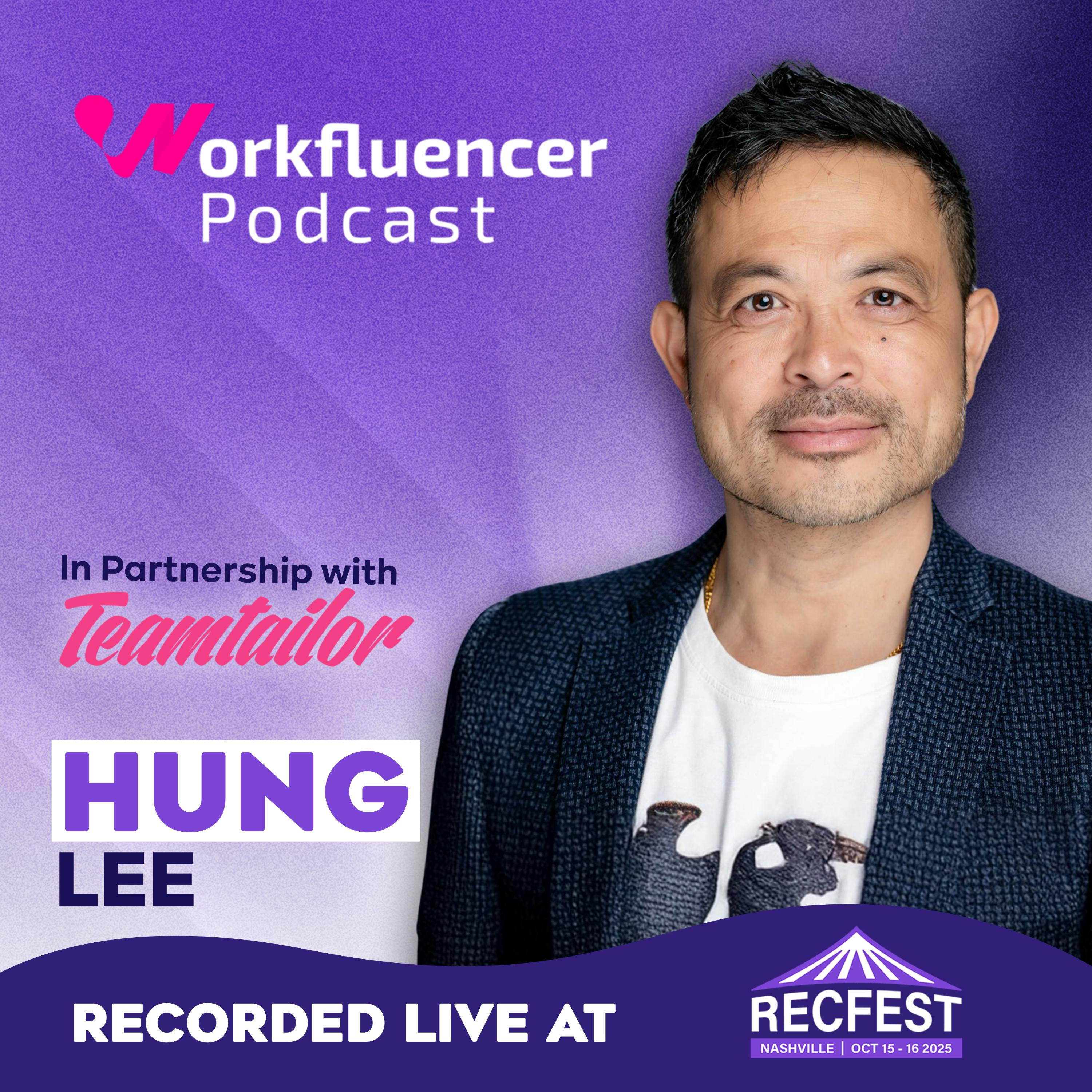


Before “personal brand” became a buzzword, Hung Lee was already doing it—building Recruiting Brainfood into one of the most trusted communities in the industry.
In this conversation, recorded at RecFest USA 2025, Hung and Rhona dig into what it really takes for recruiters to think like media brands: showing up every week, curating with integrity, and letting transparency replace polish.
He shares how an accidental send from the beach in Lisbon made him realize just how much readers depended on his newsletter. Plus, why he believes quantity beats quality, what he looks for in every Brainfood link, and how his “Open Kitchen” approach builds trust without a team.
If you create content around recruiting or employer branding, this episode is a masterclass in consistency and community.
In This Episode:
- The Lisbon mishap that proved consistency matters (when his phone blew up overnight)
- Hung’s 4-point test for what makes content “Brainfood”
- How to curate without gatekeeping
- Why recruiters should think like media companies
- The “Open Kitchen” philosophy of transparency
- Why quantity beats quality for creators
- Running a one-person media brand without a team
Thanks to the folks at Teamtailor for letting us film at their booth.
Discover why over 10,000 of the smartest companies in the world use Teamtailor to attract talent and optimize their recruitment https://link.rhonapierce.com/TTRecFest25
RESOURCES MENTIONED
- Subscribe to Recruiting Brainfood - https://www.recruitingbrainfood.com/
- Get Rhona's Newsletter - https://link.rhonapierce.com/YZEviw
- Perceptible Studios: Video Podcast Production - https://www.perceptiblestudios.com/
CONNECT WITH US:
- Connect With Hung on LinkedIn: https://www.linkedin.com/in/hunglee/
- Connect with Rhona on LinkedIn: https://www.linkedin.com/in/rhonabarnettpierce/
Don't forget to leave us a 5-star Review ⭐️⭐️⭐️⭐️⭐️
💜 Leave a review on Apple Podcasts https://podcasts.apple.com/us/podcast/workfluencer/id1740429498
🟢 Leave a rating on Spotify https://open.spotify.com/show/4R6bJ4JZpqOlFdYelWwsBr
Workfluencer, Recruiting Brainfood, recruiter media brand, content curation, creator mindset, HR content marketing, Workfluencer Podcast, Hung Lee
Learn more about your ad choices. Visit megaphone.fm/adchoices
Hung Lee (00:00.142)
Both times I was a little bit drunk, I have to say. So the first time was in Lisbon and I was doing something on my phone. I accidentally triggered the newsletter. Oh no. Right, and it went to, I know, 30,000 people. My phone is blown up, right? Everyone's calling me, they're texting everywhere, saying, Hong, are you okay? And I was thinking, what? And I realized then that I suddenly...
have a responsibility to keep this going because a lot of people might depend on it or enjoy it or whatever it is and you know what don't get drunk on a Friday night and play around the phone. I think everyone should do podcast and everyone should do a newsletter. We need a polyphonic universe folks.
There is enough room for everyone's voice in the world. most of my guests, no gatekeeping, no nothing. Yes, we need more voices like
To my newsletter on Monday, it's called Open Kitchen. Open Kitchen, why? Because these days when you go to a restaurant, you see the kitchen is open. Right? Why is it open, Rhona?
This episode was recorded live from the Team Tailor booth at RecFest 2025. Big thanks to the folks at Team Tailor for giving us the perfect spot to film this one. Before personal brand was a buzzword, Hungly was already doing it. Building trust, curating content, and making his newsletter the industry must read. Some might say he built the very first recruiter media brand. And we're here at RecFest 2025 in Nashville to talk about just that. Recruiters as media brands.
Rhona Pierce (01:26.35)
Welcome to Workfluencer
Rhona, it's my pleasure to have this conversation with you.
All right, so in case anyone doesn't know who you are, can you give us a quick elevator pitch
quick elevator pitch and I can seriously run it. I'm just a guy that writes a newsletter. So I'm a recruiter. I've identified as recruiter, worked agency, worked in-house, did all that stuff. And I just commentate on what's happening in the industry. And over time, that's just turned into a kind of a mini media business, as you mentioned. So Recruiting Brain Food Today is a bunch of newsletters. It's a podcast, a live stream. I do a lot of event support. I'm basically someone who's trying to support the entire recruiting ecosystem as best I can.
through conversation and connections.
Rhona Pierce (02:10.702)
So you started BrainFood before the creator economy was even a thing. What made you start a newsletter?
You know what, there's actually two origin stories to this and I tell them both and I'm no longer certain which is true. They may both be true. But I encountered like a serious problem because I always wanted to consume great information. But I found it took a lot of time to find the good stuff in between all the crap. So you have to click through 10 things to get one good thing. And it was like, oh my goodness, this is such a pain.
And then over time, basically just built up a list of sources that were just reliably great content. And over time, I realized I had a really good database that, you know, very useful for me. So I ended up thinking, OK, how can I share this with the people? Because maybe they've got also the same problem. I just thought, right, maybe a newsletter would be the best thing. They can just read some of the stuff I'm reading. And if they enjoy it, great. If not, also great.
no concept at the time of it being a business or being something I do full time. It was literally something I was doing anyway, and I just thought I'd make it available for others.
So you never thought it was going to be as big as it has been? When did you start realizing like, this is serious. People are like trusting this. I should take it seriously.
Hung Lee (03:21.495)
No, of course not.
Hung Lee (03:29.006)
So it was probably at the moment of an error. So one of the things that is true about recruiting BrainFood is that the newsletter is sent every week at the same time, same day, right? Religiously, it doesn't fail. But it has failed. And there has been two times when I did not send the newsletter at the right time and the right day. Both times I was a little bit drunk, I have to say. So the first time was in Lisbon.
And I was doing something on my phone, trying to check whatever it was. It was Saturday afternoon, big night night before, Lisbon, great party city. And I was like, big hangover already. I was really not feeling great. Anyway, I accidentally triggered the newsletter. Oh no. Right, and it went to, I don't know, 30,000 people, whatever. And oh no. Like once it's gone, it's gone. You can't retrieve this. And this is disastrous, the world might not even do. So anyway, I just fell back asleep on the beach. I thought, you know what?
I can't solve this now. I'll sleep for the next four hours. Let's wake up and see what's going on. So anyway, I wake up, my phone is blown up, right? Everyone's calling me. They text everywhere. They say, Hong, are you OK? And I was thinking, what? Why are they excited about this? And then I realized, actually, they knew something was wrong because the newsletter was triggered 24 hours before it should have been. Therefore, they knew I was not OK. And then I realized, oh.
That, therefore, it was important because people expected the newsletter at a certain time. And I realized then that I suddenly have a responsibility to keep this going because a lot of people might depend on it or enjoy it or whatever it is. And you know what? Don't get drunk on a Friday night and play around the phone. So, yeah, it was that moment I realized, yeah, this is important.
So this is interesting. Do you not schedule it? You literally send it yourself, like hit send.
Hung Lee (05:22.734)
I've 24 hours before. So it's there to be timely. So it's never scheduled weeks in advance because there's new stuff happening all the time. So every week it's basically the latest stuff. But usually I write it on Saturday. So I on Sunday, write on Saturday, which is why a lot of my friends don't understand. But I say, hey, listen, I can't see you then because I'm working. So I basically joke I work restaurant hours.
So it's Friday, Saturday, Sunday I'm working and then I take basically weekend on Tuesday, Monday afternoon to Tuesday.
you read all of the sources that you're sharing before adding them or do you now that's been so long you trust the sources?
You do have to read. I mean, some of the sources are very, very rich, very heavy. They could be like a 150 page PDF report. Of course, you're not reading that line by line, but you are trying to use the technology to help you. So sometimes I feed it into notebook, LLM, get to listen to it, get an early read as to whether it's got an interesting theory. There's certain sources that probably should go into the newsletter generally. So these would be the annual reports that we need to know about.
So there's a guy called Nathan Benaitj. He basically produces a state of AI report every year. It's once a year. It's a great bit of research. I think anybody who's anybody should really read that piece. So that automatically goes in. And there's other reports of that type. Otherwise, everything else is kind of forensically read.
Rhona Pierce (06:53.784)
Hey, have you subscribed? Let's fix that. It's the easiest way to support this show. Do you have people sending you stuff or does it all like come from what you hear?
No, mean submissions is a big part of it. I mean, part of the value, the fortune that I've got is that there's community spaces where people can send stuff in. So they share it on the online community. They send it to me directly. I don't give any guarantees. I just say, do guarantee to read it if you send me something. I don't have the time to respond to say no or yes. It's like, you know, feedback.
if it's
Yeah, I mean people send me stuff and they get they ask for feedback so listen I can't give feedback because that's the tenth thing I've received this morning I've just got a yes-no it but I do guarantee I read it for sure
criteria for the yes no.
Hung Lee (07:44.706)
there isn't any hard, fast editorial rule, right? Number one, I mean, the newsletter is called Recruiting Brain Food. So it has to be intellectually stimulating, right? So I've got to really read it and think, okay, that's interesting. It's caused me to think a little bit more. So anything that doesn't pass muster there, it's out. It's gotta be something that causes the brain to think. Secondly, is it from a non-mainstream source? That's quite important because mainstream, everyone knows already.
So there's no point in me recycling a mainstream news report. I assume you already have that. So I think what I can add value to is picking out sort of new sources people might not be aware of. They've never heard of this blog or is it from a different domain outside of recruiting? Great, that may be something that's useful. Number three, is it actually readable? Like you'd be amazed that some people have great content, but it's on a website with fisting with adverts and you know.
subscribe me, button all this type of stuff. It's like too much stuff going on. Like I can't subject anybody to that that's out. And then fourth, is it like free to consume? Like I can't put anything in that's got a Reg wall behind it because it's, it's, people are not looking to give information at Recruiting Brains, we don't take it out. So however good the content is, if it's behind a Reg wall, it's not going.
I love that. love that. So I take it that trust is very important to you as a curator. Tell us a bit about that. making sure that what you're sharing is something legit.
I don't always get this right. Let's fess up. I've been called out on it. Say, Hong, you've shared this. It's BS. And it's like, OK, I get it. But I don't hold myself to that level of truth. Because I think truth is something that is negotiable. Fortunately, we've come to the realization that truth is not something that is immutable. It's kind of consensus. If you think about what we've perceived to be true over the history of time,
Hung Lee (09:44.75)
There's loads of people that have thought at one point the earth was the center of the universe, right? all the people who said otherwise, they were thrown in jail and they were actually excommunicated because that truth was absolutely sacrosanct. Galileo very famously was ostracized for even uttering heresy at the time. So what is truth is mutable, goes up and down. So I don't hold myself, this must be absolutely true. Remember it needs to be intellectually stimulating. So it could be someone say something that is controversial.
and is wrong that I might even disagree with the person, but I'm saying, you know what, that person has nonetheless made some valid points that's caused us to think about this. Okay, let's say that goes in. And so you always notice that links are not shared without me commentating on them. And the commentary hopefully provides a little bit of context as to why it's gone in. It's not like, read this. It's like, okay, listen, this guy said this. I don't think that's particularly true, but you know what? It's an additional richness of the argument, which just helps us all understand
the situation a bit better.
So how do you balance your own opinions with the voices that you're sharing?
very difficult. In fact, another criticism I receive, which is a valid criticism, is that I don't share my opinions enough in that newsletter. This is true. I don't. Because there's an element where you say it's unavoidable because you are making selections, right? So editorial itself is an opinion. So it's inevitable I'm going to share things where generally speaking, I'm leaning in that direction. But I rarely put a concise argument on a particular topic.
Hung Lee (11:19.246)
because I don't feel it's my space to say that. This is a basically curated newsletter. I actually have a second newsletter where I do speak my mind. And that is, I write that on Monday. This is why I work on weekends, right? So two newsletters and two separate channels. Don't do this folks, it's extra work. But it's like, okay, I had this conflict because I wanted to say my piece. But you know what?
I also wanted to curate other stuff. It shouldn't just be a foghorn for Hong Lee. This is the curated stuff, intellectually interesting stuff for recruiting. You read that and then if you want to hear my voice in terms of what it is, I really think about certain things. I'm writing it here.
I love that you've separated that because it is hard when you're just sharing or curating like to add your opinion. It's like, you you want to highlight the person that wrote the piece or created it.
Yeah, you want to highlight the argument even though you may not agree with it. It may be just an important position within the industry or it's a position a lot of people resonate with. I think it's worth to put in because it stimulates that conversation. But yeah, it's not you basically. You've to get yourself out of there.
So let's switch gears a little bit and talk about a lot of recruiters today run podcasts, YouTube channels, newsletters, and they're building personal brands. Do you think that's where our profession is heading?
Hung Lee (12:45.71)
I think everyone should do a podcast and everyone should do a newsletter. Everyone should be much more vocal online. And I know a lot of people listening to this will think, my god, do we need another podcast? Yes, you do. Yes, you do. We need a polyphonic universe, That means many, many more voices contributing to the political discourse, to the cultural discourse. Don't have any one single voice dominate this. This is BS. So I always endorse and support anybody else that wants to go ahead and do this.
I don't gatekeep, I know a lot of people are very territorial, hey, I'm the one doing the podcast. No, you're not. You're just one guy and you're another person doing it. The more voices, the better. Rhona, I'll tell you this. We are very, very precious. We understand the value of privacy, right? We defend our privacy. This is important. Absolutely, it's the case. But for some reason, we ignore our publicity, right? We deny that's important, equally important. We have to possess our privacy, but we also have to own our publicity as well.
Your voice needs to be heard in the universe. You've got to contribute to it.
you
I love that. I'm a firm believer in that as well. And I always say it on this podcast, there is enough room for everyone's voice in the world. most of my guests, no gatekeeping, no nothing. Yes, we need more voices like this in our industry, especially because we're so misunderstood in what we do. And I think I've always said it, we have a perception problem and it's kind of like our fault. So the only way to fix it is if we talk about what we do and change that perception.
Hung Lee (14:17.838)
Right, couldn't be more right.
Quick break. If you've been thinking about starting a podcast but don't know where to begin, I've got something for you. I'm letting woman in TA, HR, or employer brand take over the Workfluencer podcast for one episode. am so excited to be able to do a podcast takeover and I'm joining Rhona Pierce today as a guest host. Rhona is the creator of the Workfluencer podcast. You get a behind the scenes look at how I plan and produce everything.
I handle all the editing and you walk away with a fully edited episode, social clips, and the audio to launch your own pod if you want. If that sounds like your kind of test drive, head over to workfluencerpodcast.com to apply.
Rhona Pierce (15:04.94)
What do you think that people get wrong about building their personal brands?
I think they spend way too much time thinking about content quality. So quality is totally overrated, right? Quantity is much more important than quality. You can quote me on that, right? Just get your stuff out. Get your stuff, get it out, for high volume, high frequency, get it out. You will get better with the reps, right? So too many people spend too much time doing all of the production, getting all the lighting right, doing all of this stuff. Look, I get it, know, great production, great AVs, fantastic.
But if you're starting out, you're already wasting too much time doing those things, get your phone out, talk into the phone and get it out, right? And the reps will improve you as you go. So I would say that is the thing that people get wrong with content creation generally.
I agree. I agree with that because especially with what I do I get so many people coming. Do I need to buy a new camera? I need to? No, no, no, no, no. Get out. I started with an iPhone, an old one, and as you go your production quality increases, your content gets better, all of that. How do you use AI in your curation?
I don't, it may surprise a lot of people, but I'm actually quite AI light. And I did a survey on the recruiter community, say, hey guys, it's been like three years since chat.gbt, what are you doing? And like 500 people responded and like 70 % said, yeah, I'm still pretty basic. And I said, yes, I'm totally basic, I'm with you. In other words, I use it, what, to do research. I use it to do like maybe some early drafting and that's about it.
Hung Lee (16:48.654)
So there's no automation, there should be. So I think I've got the same problem as everyone else. Like your bandwidth is a problem. And when you're trying to implement a new way of working, you kind of have to stop what you're doing now in order to build a new system. And for me, I've just failed to do that. So this could be, arguably this may just be a lack of discipline or lack of ability to do various things. Totally fessed up maybe the case. Or it simply is a scenario where...
The rhythm of the cadence I've got right now, it's difficult to stop. So there's three hard points every week. Newsletter Sunday, newsletter Monday, podcast webinar Friday, hard stops every single week. It's expected. So that rhythm basically stopped me really from creating a new way of working. Maybe I need to take a break. I might need to take like a two month break from everything and then respool it. But you know, do I want to do that? Does the audience want me do that? I don't know. So yeah, AI-Lite.
team or do you do everything pretty much your
No, no team. The initial sort of concept, not concept, but when BrainFood became a business, I thought, you know what, I wanted to experiment to see how much one guy can do. Like what is the possibility of one person doing everything? How much can you make? How big a business can you do it? I mean, you can't make a big business, is the truth. However, you can max it out to a certain level. So I'm happy with that journey of being like quite light in terms of the human resource.
But probably I need more people around to help do the things that I'm talking about, particularly to renovate and become more efficient that actually needs to temporarily become less efficient because I need to get other resources in place to help out.
Rhona Pierce (18:32.558)
That is really impressive that you do the volume, the amount of content, the quality that you do without a team. It's impressive. I actually always thought you had a team.
smaller than I am, you know? It's just me.
What is something that you wish recruiters understood about building an audience?
We always underestimate the mundane. We always think that we need to say something profound or have a complete argument over a complicated topic and say, is a piece of genius. We forget about the details, the small things that happen. And we don't think they matter. But from the outside in, people don't actually know that those things occur. So the small, mundane things that you think, actually, who is interested in this? They're the most interesting things. And that's where you blow up.
If you think about some of the TikToks that really are successful, a lot of them are like a workman doing stuff like plumbing, you know what mean? And a cleaning pool, there's a pool cleaner, do you follow that guy? All he does is clean pools. And it's more or less the same 60 second video every time. But you know what, I did not know about pool cleaning techniques. I did not know that this is how you set it up. And suddenly he's got like 18 million views, right? So think recruitment is the same.
Hung Lee (19:50.606)
We assume everyone knows, no one knows, and we assume what we know is boring and that's not the case. So the mundane, lean into the basics and surface that up.
I've enjoyed this conversation, but it wouldn't be worth the answer if I didn't ask one spicy question at the end. no thinking, no anything, just whatever first comes to mind.
This is career ending moment right now. I can feel it.
What's one trend that you completely misread? thought it was going to take off, you did your predictions and it...
It's really interesting because I do an annual predictions every year, 20 predictions. This is what's going to happen 2025. I've reviewed it recently. got none of them right. Actually, I got two or three right, but most of them are completely off, right? It's like, oh shit, didn't get that right. One trend I did not get right. Let me just think there is, I tell you what, there is one. My brain is absolutely fried on this, but let me see if I can grab this. You know, it's one of those ideas. There's a slippery worm in your brain.
Hung Lee (20:51.872)
slipping out, slipping out, sorry everyone it's gone. No idea, I'll come back to you in it.
I was going to ask if there's anything that I haven't asked that you think recruiters listening, employer branders listening should know about being a media brand.
I think it's maybe you're inevitably a media brand. Like you can't have a null experience here. You're going to be judged one way or the other. And I was having a conversation with some of the EV folks over at Happy Dance there and they were saying the same thing. It's like, look, at the end of the day, you may say you're completely not involved in this. Guess what? People on Reddit are talking about your company. So you can't not have a brand. So I would say the advice to everyone is that you have to embrace our publicity.
We have to be, and the way to do that is simply to be more transparent what you're doing. So my newsletter on Monday, it's called Open Kitchen. Right, Open Kitchen, why? Because these days when you go to a restaurant, you see the kitchen is open. Right, why is it open Rhona? Because 30 years ago that kitchen was not open. The only time you see the food, you learn the way that comes out and serves the food to you, right? The reason why it's open is because it creates trust. Because suddenly the diners can see, oh, this guy is actually making the food.
I can see he's wearing gloves and actually the hygiene level is okay. And actually there's another dude frying this thing. It's being cooked, it's not microwave. So you create trust simply by opening the door. It's not extra effort, it's actually less effort. You don't have to hide behind what's going on. So I think you take the concept of open kitchen, you apply it personally, you apply it professionally, I think it's gonna work out for you. Unless you're a serial killer or something terrible like that.
Rhona Pierce (22:31.438)
That's a whole other story. So I really enjoyed this conversation. How can listeners connect with you?
Listeners can connect, recruitingbrainfood.com. It's a newsletter, sign up to that. You can talk to me through there. And then if you Google Hong Li somewhere, probably I'm the first couple of, there's another value by the way. I've been media everywhere, quantity over quantity, quality. So you're on Google on first page. So Hong Li, basically any of those things, follow that and you'll be fine. My pleasure, Rhona. Great chat with you.
Thank you so much for being on Workfluencer.
Rhona Pierce (23:02.776)
Thanks so much for listening. If you're enjoying the Workfluencer pod, share it with someone who's changing how we talk about work or who should be. And hey, if this episode gave you ideas or inspiration, leave us a five-star review. Reviews help other listeners find us. And honestly, it makes my day. Workfluencer is produced by Perceptible Studios. Learn more about how we can help you use video to attract, engage, and retain qualified talent at perceptiblestudios.com.
Thanks for listening and I'll chat with you next week.

Founder
Hung Lee is one of the most influential voices in talent acquisition — and one of its sharpest curators. He’s the founder and editor of Recruiting Brainfood, the weekly newsletter read by thousands of recruiters, HR pros, and founders around the world. Through his live show Brainfood Live, Hung has turned conversations about recruiting, automation, and the future of work into a global community movement. A former recruiter and startup founder (Workshape.io), Hung has built his career around connecting people, ideas, and technologies that are reshaping how we hire — and how we think about talent.


